Sometimes as foreign students, we get asked to do random things which, possibly because of the language barrier, we unwittingly agree to do. About two weeks ago, I got asked by our school administrators to learn to play and sing a song in Chinese to represent our school of international students. I agreed.
Later, I found out that the song needed to be recorded and shot on video, and that the video would be submitted to some national talent competition for schools with international students, showing off these students' embrace and learning of Chinese culture. Some show off their Chinese calligraphy. Others read Chinese poetry. Some perform classical Beijing opera.
But for me and one of my classmates here at the school... we decided we would cover a popular song by Jay Chou. Jay Chou, if you don't know, is super-popular in China. He recently also starred as Kato in The Green Hornet.
So here it is. 简单爱 ("Simple Love") by Jay Chou:
If you're interested in the lyrics translated, the Jay Chou Lyrics Blog has them. Personally, I think the lyrics seem a bit strange when translated into English. ("I want to watch baseball with you" and "I want to take you to my grandma's house" for some reason sound perfectly fine in Chinese, but sound kind of hokey in English)
Oh yeah, if our competition entry gets selected for the next round, we apparently get to perform live on some stage in Beijing. I'll keep you posted, but I think it's highly unlikely.
Showing posts with label Chinese. Show all posts
Showing posts with label Chinese. Show all posts
Monday, June 27, 2011


Monday, May 30, 2011
Conversation Expectations
 We have learned quite a few things since moving overseas 2 years ago (that's right - yesterday marked the 2-year point of our arrival to this country). One of the things we have learned is how awkward-but-must-have conversations are to be conducted here. Learning this has helped us to have good expectations, preserve relationships, and avoid frustration.
What is an awkward-but-must-have conversation? Something like... discussing with your landlady about renewing your apartment lease for a year, and negotiating the rent for the coming year. That's the conversation that I had tonight.
In the States, there would probably be no conversation. You would get a notice on your door (or maybe an e-mail) that says, "Your annual lease will be expiring in 30 days. You are hereby notified that, if you would like renew your lease for the coming 12 months, your rent will increase by 14%. Please notify the property manager if you would like to renew your lease, or give proper notice of your intent to vacate your apartment. Thank you." There... that only took 2 minutes to read. Everything black and white. Choices are clear. Move along.
It's not like that here. Instead, it starts like this...
Two weeks ago, I run into my landlady while walking home. I say, "Oh, by the way, our lease is about to be up! We should talk with you sometime about renting for the coming year!" She says, "Oh yeah, that's right. Well, when the time comes, we'll talk." (Literally, she says, 到时候我们再说吧, which means, "When the time comes, we'll talk.")
Then a few days ago, I say, "Wow, look at that... the time has come! We should talk!" She says, "Ok, we'll connect sometime next week."
Then today she calls me and says, "Did you want to talk about renting for the coming year?" I say, "That sounds like a good idea. Thanks for bringing it up! Sure, let's talk!" She says, "Ok, come on over to our home tonight after dinner."
By now, we have had three conversations about the rent, but we have also had zero conversations about the rent. Tonight's conversation, at her home with her and husband... this would be the conversation. And I knew to set aside at least 90 minutes for this conversation.
I go over to their home. We all know why I'm there. We all know what we're gathering to talk about. But, we do not get right to the point. That's not how things work here. If I walked in and said, "Alright... so, let's talk rent..." - that would be awkward and disrespectful. What's more important is the relationship we have with each other, not how much rent they're going to charge. So, I sit. We talk.
We talk about where we all traveled during May 1st holiday. We talk about whether we're going to travel for the upcoming Dragon Boat Festival Holiday. We talk about how work is going, how the business registration process is going. We talk about looking for office space. We talk about how office space is a lot cheaper on this side of town. We talk about how everything seems to be getting more expensive these days. We talk about their daughter. We talk about how much homework she has. We talk about how learning Chinese can be pretty difficult at times for us.
We talk about a lot of things, but we all know what I'm there to talk about.
After about 40 minutes of chit-chat, my landlady says, "Oh... so, about the rent..." And then they refer back to the part about everything getting more expensive these days. They say that they did some calculations, and rent is going to have to go up this year. Up by 7.8%. "Oh, I see. Hmm...," I say. No quick answer. No visible reaction from me one way or the other. It is not yet time to end this conversation. So, we talk more.
We talk about the other apartments they're renting out, and how much rent has gone up or will go up for those apartments. We talk about how much the rent increase was for us last year (13.3%). We talk about the baby that's on the way. We talk about whether it's more of a financial burden to raise a boy or a girl in this country. We talk about the benefits of renting a home instead of buying.
My landlady goes to the fridge to bring out a bag of bamboo-leaf wrapped sticky rice (粽子), which she made for us. After all, next week is Dragon Boat Festival. I say thank you. We continue talking. I have now been at my landlady's home for 75 minutes.
When I find a good segue, I say, "Oh yeah, so... about the rent. I understand why it needs to go up this year. It makes sense. After all, the cost of everything seems to be going up this year. What do you think about a raise of only 5.8%?" (I'm using percentages here, but we were talking about RMB amounts.) The husband hears the number, asks his wife, "What does that come out to?" She calculates. He says, "Yeah, yeah... that should be fine. Close enough. After all, we're all friends anyways!"
There. The deal is done. But... you can't just end it there and say, "Alright. Well, we're all settled then. I'm off now!" That would make it look like the only thing you came here to talk about was the rent, and now that the rent's settled, you want nothing else to do with them. Come on, you should have learned that by now!
So, we talk. We talk for another 15 minutes. The weather. Raising children. Whether or not a woman should wash her hair for the first month after giving birth. Whether or not not washing her hair is linked to later-in-life arthritis in her knees. The standard stuff.
90 minutes in, I say, "My my, look at the time. Well, thanks again for letting me come over, and also for the 粽子 - these will be great! Oh yeah, I'll get that rent money to you first thing on Wednesday. I guess I should head home to the wife now...!"
And then, I walk home. 90 minutes well spent. The rent conversation is done. Rent went up, as expected, but only by a reasonable amount. Relationship is intact, if not even strengthened, perhaps. And, going in with the expectation that this would be a 90 minute conversation wherein only 6 minutes of the conversation would deal with the actual topic of rent... having this expectation definitely saved some frustration. All in all... a good evening, and a good conversation.
Sunday, May 8, 2011
Too Much English, Perhaps?
 Recently, Bethany and I have been spending some of our Saturday afternoons at the city library, just to study and be in a nice study environment. In recent weeks, my Database Class professor has been coming too, to bring her 6-year old daughter to see me in order to practice English. This has been alright - it was something that I agreed to do. It gives Bethany about an hour of time to chat with my professor, which is great language practice for her. And my professor's daughter is totally adorable and smart.
This last Saturday, it turns out my professor was also babysitting a 6-year classmate of her daughter, a boy who has very little interest in learning English but has tons of interest in cars. So, this boy came along too for the English lesson. After about an hour of working through English together - me and these two 6-year olds - we called it a day.
The boy ran to the magazine racks to get magazines about cars, and then he came back to talk to me nonstop about this or that car... all in Chinese. I couldn't understand a lot of what he said.
My professor said to him (in Chinese), "Shao Ge, you have to speak slower to uncle when you are talking to him. Uncle doesn't understand all of the Chinese that you are speaking."
The boy looked at me curiously, and then looked back at my professor. "Is that because he spent too much time learning English?"
Yes, Shao Ge, you nailed it. That's exactly it.
Tuesday, February 22, 2011
What Millions of People Hear at 5:50PM Every Day
Are you ready for this? It's... Kenny G.
In the last 18 months, Bethany and I only made a minor mental note of this whenever we were in shopping centers here in China near closing time. I remember when we were buying furniture in a giant warehouse. Right around 10 minutes to 6, we heard that familiar soprano saxophone. Another time, I was in a department store mall just before closing. And sure enough, there was Kenny G again. We would look at each other, puzzled, and think to ourselves, "That's weird. Isn't that the same song we heard over at... when they were closing for the day too?"
This last Sunday, we went to check out the city public library. It's a 4-story, well-lit but somewhat sterile-feeling library with book stack rooms, lots of reading rooms, free wifi, and electrical outlets. It has a large and open center atrium, and all of the rooms are separated by glass. We spent about 4 hours there - Bethany did some Chinese studying while I setup a local Rails development environment on my machine.
At 5:45, we said to each other, "Do you think this place closes at 6? Oh well, I guess we'll wait and see." Then, 5 minutes later... the loudspeakers began blaring that familiar song.
Before shutting down, I quickly wikipedia'ed Kenny G. I needed to find out more. Why does everybody play this song?
It turns out that "Going Home" is a very popular song in China, played at many public places when they're about to close. The article goes on to say that in Shanghai and Tianjin, the subway even plays this song when the train is nearing the final station for the line.
We also noticed just how ingrained this song is in the minds of Chinese people. As soon as the song started to play, the people around us just naturally began to pack up their things to go. It was almost like a Pavlovian conditioned response. Kenny G = time to go.
We decided that we are going to keep an mp3 of this song handy in our home. If we have guests over and they're beginning to overstay their welcome, we're going to play this song on the stereo and see what happens.
In the last 18 months, Bethany and I only made a minor mental note of this whenever we were in shopping centers here in China near closing time. I remember when we were buying furniture in a giant warehouse. Right around 10 minutes to 6, we heard that familiar soprano saxophone. Another time, I was in a department store mall just before closing. And sure enough, there was Kenny G again. We would look at each other, puzzled, and think to ourselves, "That's weird. Isn't that the same song we heard over at... when they were closing for the day too?"
This last Sunday, we went to check out the city public library. It's a 4-story, well-lit but somewhat sterile-feeling library with book stack rooms, lots of reading rooms, free wifi, and electrical outlets. It has a large and open center atrium, and all of the rooms are separated by glass. We spent about 4 hours there - Bethany did some Chinese studying while I setup a local Rails development environment on my machine.
At 5:45, we said to each other, "Do you think this place closes at 6? Oh well, I guess we'll wait and see." Then, 5 minutes later... the loudspeakers began blaring that familiar song.
Before shutting down, I quickly wikipedia'ed Kenny G. I needed to find out more. Why does everybody play this song?
It turns out that "Going Home" is a very popular song in China, played at many public places when they're about to close. The article goes on to say that in Shanghai and Tianjin, the subway even plays this song when the train is nearing the final station for the line.
We also noticed just how ingrained this song is in the minds of Chinese people. As soon as the song started to play, the people around us just naturally began to pack up their things to go. It was almost like a Pavlovian conditioned response. Kenny G = time to go.
We decided that we are going to keep an mp3 of this song handy in our home. If we have guests over and they're beginning to overstay their welcome, we're going to play this song on the stereo and see what happens.
Tuesday, August 31, 2010
日常用品 = Everyday Items
 We had class in a different classroom today, and I noticed a poster that I had never seen before. Sorry for the slight blurriness.
The title of the poster is 日常用品. Translated, this means something like "Everyday Items" or "Daily Use Items."
I was struck by 1) how dated this poster is, and 2) how culture-specific many of these everyday items are.
Have you picked up your ping pong paddle today?
How about your life jacket?
Abacus?
Squirt gun?
Saturday, May 1, 2010
I Am Have Many Question
This announcement flyer posted right outside our building for international students learning Chinese. For an English-only flyer, I would put the grammar and word usage at about 95th percentile relative to everything else we've seen out here that's in English.

What's interesting to (besides the English) is that, you would think that - if there was anybody on campus who had an English operating system on their computers - it would be the foreign students. I don't understand why we are their market audience.
And also... in regards to operating systems, anti-virus software, or other software... who wants to make a bet that this is authentic non-pirated software?
What's interesting to (besides the English) is that, you would think that - if there was anybody on campus who had an English operating system on their computers - it would be the foreign students. I don't understand why we are their market audience.
And also... in regards to operating systems, anti-virus software, or other software... who wants to make a bet that this is authentic non-pirated software?
Friday, April 23, 2010
Buyer Beware
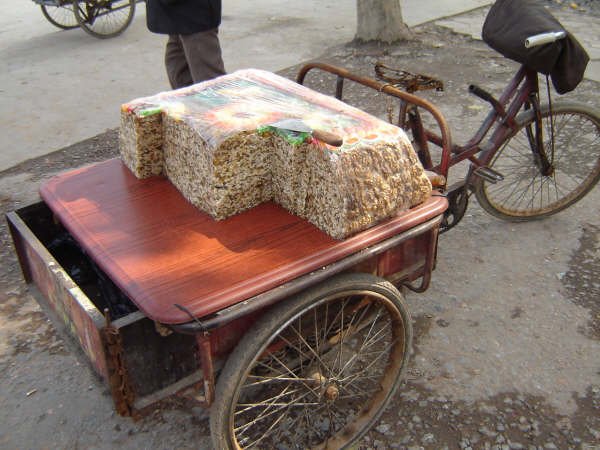 As I biked out of the campus gates on Wednesday after class, I approached three friends (foreigners like me) who were huddled around a bike cart vendor. From the look of the vendor and his cart, this was a man from a different region of the country, who was selling pieces from a special fruit and nut cake that is one of their cultural foods. (The picture to the left is of a cake similar to the one we saw). I rode up to my friends to see what they were up to.
Well, apparently, they were asking about how much a piece of the cake would cost and they asked the man to cut just a small small little piece for them to buy and then take home to try. This is right when I arrived... as the vendor had just cut a huge piece (about the size of tissue box). And I arrived right in time to hear him say (in a thick accent), "108 RMB."
Now, my language skills aren't super wonderful, but I am a bit farther along in the classes than my friends there. They were looking at me to make sure that they had heard correctly. 108 RMB? Seriously? 108 RMB can buy you about... 8 pounds of beef. And this piece of cake, of which they only wanted a small piece, was going to cost them 108 RMB?
The vendor was staring at them, continuing to demand the money while putting the piece of cake in a plastic bag. I told my friends, "Uhh, guys... you seriously need to walk away. Like, walk away... now." They said, "Bu yao. Zou le." (We don't want it. We're leaving.) And we all started to make our move.
This is when it got interesting.
The vendor began to pursue us, yelling at us. He grabbed my friend by his backpack shoulder strap and shoved the cake into my friend's chest, yelling, "I already cut it. You have to buy it." He just kept saying it over and over again, louder and louder. "I cut it for you. I'm selling it to you. 108 RMB. You told me to cut it. Now you have to buy it."
My friend kept looking at me, saying, "Tell him I didn't ask him to cut that big of a piece. There's no way we're going to buy this." I translated. And there began a nice loud argument between my friend and me and this vendor who would not listen to us (nor let go of my friend's backpack).
Finally, I said to him, "My friend just wanted a small piece. You cut us a small piece, and we'll buy a small piece. But not this." The vendor grumbled and we went back to the vendor's cart. Now... a small crowd of maybe 15 people has gathered around us.
The vendor cuts the cake piece into two, takes the bigger piece and begins to bag it up for my friend. My friend and I both know that this not how we want this to end. So I tell my friend again, "Look, just walk away. Go... quickly." And so he starts walking.
Seeing that my friend is walking away, the vendor grabs my bike and won't let go, and he puts the cut piece into my bike basket, and he yells at me, "If your friend doesn't buy it, then you have to buy it. I already cut it. You have to buy it."
I argue with him, "Why should I buy it? I was just passing by, and I saw my friend. He didn't understand what you were saying, so I was just translating for him. I don't want your cake." But he will not let go of my bike.
It's interesting to me how many things go through your mind when you're in a heated situation. Because the vendor was, by this time, super aggressive, I was thinking to myself, "Would this guy seriously take a swing at me? With all of these people gathered around us to see? He wouldn't... he would look really bad if he did. But what would I do if he did?"
My friend, seeing that the vendor would not let me leave, came back. By now, a few of the people around us tried to be of some help. A few of them asked me, "Why did you ask for such a big piece if you weren't going to buy it?" I answered, "You all know we didn't want a big piece. My friend wanted a small small piece, and this man cut it that size on purpose so that he could make money." As soon as I said that, they all understood immediately what was going on, that this guy in fact was trying to 宰 (zai3 = "slaughter") a few foreigners. This is not uncommon.
Finally, we pointed to the smaller of the two pieces and said, "We won't buy this bigger piece. How much is the smaller piece?" He replies, "42 RMB. You can give me 40 RMB."
At this point, a surprising thing happened. A few of the local people gathered around us said to me and my friend, "How about this... we'll all buy it together for 40 RMB. I'll buy a little, and my friend here will buy a little, and then you guys buy a little..." Besides the occasional vendor who wants to 宰 foreigners, I'm continually struck by how kind the people of this city are to its foreigners.
Realizing that we were not both going to be able to walk away without buying at least something from this guy, my friend agreed to pay him 40 RMB for a slice of fruit cake that I'm sure he didn't even want anymore. He handed over the money, and we walked away, probably both feeling a mixture of relief and anger.
I was, however, thankful for the out-of-the-ordinary language opportunity. It's funny to me how, for the next few hours following the encounter, I was fashioning and rehearsing in my mind different sentences that I wish I had tried out. Things like:
喂哥们儿,别抓住我的车。放手。 (Hey buddy, let go of my bike.)
废话! 你怎么这么对待我们啊?! (Nonsense! How can you treat us like this?)
滑稽不滑稽?你找打吗? (Funny guy, eh? Are you looking to get a beating?)
Thanks, ChinesePod, for the last one, even though I probably won't ever have the guts to bust it out.
Last night, I found out that two other friends of ours, also foreigners, had passed by the fruit cake cart about an hour before we did. They didn't get the language and culture experience that we did. Instead, they quietly (and regretfully) paid 126 RMB for their piece of fruit cake.
Monday, January 11, 2010
阿凡达 = Avatar
 Tonight, I saw my first movie in a Chinese movie theater. 阿凡达 (ā fán dá). And it was all in Chinese.
 While I do feel like the movie itself was excellent, I think more significant for me was that I feel like the entire experience was excellent. Here are some reflections...
Watching a Movie In Chinese
At first, we were a little hesitant about whether we would be able to track with everything going on. Maybe this is because of Bethany's experience watching Up back in August. But fortunately, the plot for 阿凡达 was not all that intricate (actually, I would give it a 9.5 on a 10-point scale for predictability). This meant we were able to anticipate the storyline, and so, anticipate the dialogue content. That, coupled with a semester of good language study, meant we were able to understand most of what we were listening to during the movie. A huge encouragement!
Watching a Movie in a Chinese Theater
This is, from what I hear, the nicest movie theater in our city. And it is really nice... clean, comfy seats, good sound system. You wouldn't even know that you were in a movie theater in a different country. Except for a few things.
First, pre-assigned seating. You choose your seat when you buy the ticket (our friend went early in the morning today and waited for 40 minutes just to buy tickets!).
Second, there was no pre-movie commercial that told everybody to turn off their cell phones and not talk during the movie. There wasn't a lot of talking during the movie, and I counted maybe only half a dozen cell phone rings through the movie. Oh, and the guy sitting next to me did actually answer his cell phone and talk (as quietly as he could) for about 30 seconds. But maybe we're just used to that being how this culture is. And so, it didn't bother us. Actually, I was pretty pleased that it was as quiet and cell phone-free as it was.
Watching a Movie in 3D
We paid a little bit extra for the 3D showing (ticket cost: ~USD $9), and used special 3D glasses and everything. Well worth it. The movie was beautiful. Bethany said that this 3D showing was way better than the showing of Up in this theater a few months ago.
What was particularly striking for me how people around us were constantly oooh-ing and ahhh-ing at the beautiful scenes in the movie, and some of the 3D special effects. I noticed their oohs and ahhs, I think, because we don't do that so much in the States anymore. We're so used to our movies, and we have such high standards for these things, even the really good ones don't make us ooh and ahh all that much anymore.
But for people here, I don't know that they get to see movies like this (and in this way) all that often. Most likely, most of them will never go to Disneyland and ride Star Tours - but they would be blown away if they did. They will likely never see an IMAX theater, let alone see a movie in one. They'll probably never see Les Mis at the Pantages, or Cirque at the Bellagio.
It was enjoyable for me to experience having people around me enjoy their experience and really appreciate the beauty of the movie.
Watching a Movie as a Foreigner in a Foreign Land
Without giving away too much about the movie (though what I say here you could glean from any trailer), a major subject in this movie has to do with being an outsider and throwing yourself into a foreign, alien culture. Beyond just learning their language... learning their culture. Learning about how they communicate and what they value and how they connect with one another. Learning about how they see nature or family or life or death.
I felt like this particular aspect of the movie was one with which I immediately connected - in a way that nobody else in the theater did or could (besides Bethany and one other friend of ours)... because right now, we are outsiders immersed in a foreign culture. That aspect, and that especially, is what made this movie experience an excellent one.
Tuesday, December 22, 2009
Identity Crisis Resolved
 You may recall back in October when I first wrote about my identity crisis. To recap, for all these years I had only known how to say my name in Cantonese. When it was translated for me into Mandarin Chinese a few years back (coupled with me not really remembering too clearly exactly how to write it), I ended up with the 2nd character in my name written... incorrectly. This was not discovered until my parents came in October, saw my student ID card, and thereby informed me that I had written my name wrong.
 Imagine if you were male and your name was Miguel, and you lived in Mexico. Upon moving to the United States, you decide to choose a more-English sounding name. Well, naturally, Miguel probably translates over to Michael... but some Spanish and English speaking friend of yours decides to translate your name to Michelle instead. So, for your first semester of college in the United States, all of your friends and teachers call you... Michelle.
So, ok, maybe my situation was not so drastic - I think the incorrect Chinese name I had through this semester was gender neutral. But still, it was slightly embarrassing letting my teachers know one by one that, well, I spelled my name wrong this whole time.
Last week, I pulled the trigger and asked our department administrator to change my name officially - to the correct character. I received my new student ID today (with the same picture, heh heh!). My name is now written as it should be. But it will take some getting used to for my teachers and classmates to begin calling me by my correct name, and for me to respond to it.
Wednesday, November 25, 2009
A Vist to the Butcher
 One of my favorite open-market activities is to visit the butcher. The butcher's shop is an open 8 feet by 8 feet booth. When you go to the butcher, here is what you'll see:
- A long rack with meat hooks, on which are hanging 6-10 skinned cows and sheep - we're talking, whole animals, minus the head, the innards, and the hooves.
- The meat grinder and the scale at the back of the booth.
- At the front, a little counter with different parts of a sheep already cut and laid out.
- In the middle of the booth, a little coal furnace heater for warming your hands (it's winter, it's outside, and it's cold)
- Two stools.
- The chopping block. The chopping block is a tree stump - about the size of one of the small round tables at Starbucks. This chopping stump is never washed (that I can tell), and is just red and white from all of the bits of meat (and fat) chopped on it all day (week, month, year) long.
Whenever I visit the butcher now, he invites me to come sit in the booth with him just to hang out. Our family and their family have become friends. I could sit in that booth for hours.
But I should warn you, sitting in the booth... may not be for the faint of heart.
Today, when I went by, one of the stools had a huge cow hind leg bone on it. Hardly any meat on it, used for making soups... but huge like a bowling pin huge. The butcher said, "Come on in and sit awhile!" He tossed the bone off to the side, took that stool (phew), and gave me the other one. We sit and we talk.
I love going there because he's very friendly and does most of the talking, which is great listening practice for me. And, I love watching him interact with his customers. A lot of customers usually bicker with him, saying this or that piece of meat is too fatty or has something wrong with it - they say that to try to get a lower price. But he knows that he sells good meat, and he knows that they'll buy it. So he'll argue with them. In the end though, it's all just playful banter, a pretty typical shopkeeper-customer interaction.
Oh yes, and as you sit in the booth, you get to watch him chop the meat - bones and all - on the chopping stump, with his giant chopping knife (seriously, the blade is about the size of a box of See's Candies Nuts & Chews). Little bits of meat and bone go flying everywhere - yes, sometimes even onto my clothes. Today, I watched him chop the bowling pin beef bone into four pieces. It was sold for 16 kuai, to be used in a soup.
A few weeks ago, I recorded some of the butcher's interactions with two older women who had come to buy some leg of lamb. You can get a taste of what the butcher shop is like by listening to this one-and-a-half minute clip. Oh, you'll also notice that there is quite an accent, both from him and the women.
At first, you'll hear one of the women tell him not to bother taking the lamb leg off the hook... it's got too much fat. "Too much fat? No...", he says, while taking leg down and getting ready to chop it for her. Then the lady says something about lamb tail. They continue to bicker about the lamb leg. He says, "Fine fine, I'm going to chop up the leg for you and get it all ready. You go walk around the market... if you find a better leg, buy it. If not, you come back and take this one." See, he knows they'll buy his meat.
Then you hear him chopping. Imagine bits of bone and flesh flying into the air.
At the end of the clip, he tells them it's 97 kuai. Then the two women start bickering with each other, each wanting to pay for it. He tells them not to grab, not to grab... he'll take their money either way. And at the end, I think you hear the women saying the meat (and the price) is ok after all.
Saturday, November 21, 2009
Extracurricular Chinese TV
A lot of our Chinese friends tell us that we should watch Chinese soap operas to help improve our Chinese. I don't doubt that - conversational dialogue is one of the best things to learn. But I haven't really spent too much time researching on what actually is a good soap opera series to watch. So... that one is on hold.
In the meantime, I have found a different show for my extracurricular Chinese TV (er, watched on our computer, that is, since we don't have a TV). It is...
托马斯和朋友 (tuō mǎ sī hé péng yǒu).
For the English speaking 3-year-olds out there... that would be "Thomas & Friends." Yes yes... Thomas the train.
Thomas & Friends launched in Chinese in April of this year, airing on CCTV-1. I've been able to find about 30+ episodes online.

It is all in Chinese, along with Chinese subtitles. It has been a great way to hear some basic language, basic conversation, and cover some fun topics. So far, I have learned about bravery, pride, sacrifice, asking for help, and forgiveness.
So, can you guess the trains below based on the Chinese transliteration of their names?
托马斯 - tuōmǎsī
邓肯 - dèngkěn
艾蜜莉 - àimìlì
高登 - gāodēng
培西 - péixī
And as a bonus, who is this character (not based on transliteration)?
胖总管 - pàngzǒngguǎn
In the meantime, I have found a different show for my extracurricular Chinese TV (er, watched on our computer, that is, since we don't have a TV). It is...
托马斯和朋友 (tuō mǎ sī hé péng yǒu).
For the English speaking 3-year-olds out there... that would be "Thomas & Friends." Yes yes... Thomas the train.
Thomas & Friends launched in Chinese in April of this year, airing on CCTV-1. I've been able to find about 30+ episodes online.
It is all in Chinese, along with Chinese subtitles. It has been a great way to hear some basic language, basic conversation, and cover some fun topics. So far, I have learned about bravery, pride, sacrifice, asking for help, and forgiveness.
So, can you guess the trains below based on the Chinese transliteration of their names?
托马斯 - tuōmǎsī
邓肯 - dèngkěn
艾蜜莉 - àimìlì
高登 - gāodēng
培西 - péixī
And as a bonus, who is this character (not based on transliteration)?
胖总管 - pàngzǒngguǎn
Thursday, November 19, 2009
Extracurricular Chinese Reading
As part of my language learning, I decided awhile ago to find some extracurricular reading. So, I have picked up 3 books which I have been "reading" in the last few weeks. I say "reading" because it's definitely not like I understand everything that I'm reading. I see how many of the characters I can pick up as I go along, guess at the meanings of other characters based on context, and try to draw conclusions about main ideas or points here and there. Once in awhile, if there's a character I keep running into, I'll take the time to look it up and learn it.
This is helpful for me in retaining characters, basic reading comprehension, and in seeing how words ought to be used when in their proper contexts. And best of all... there's no pressure. No assignments to complete, no teachers to answer to. Just... leisure reading.
Of my 3 books, there's really no rhyme or reason as to which book I choose to pick up on any given day. Maybe it's my mood, my current interest, my desired level of difficulty, or how long I think I'll last before I fall asleep.
Currently, here are my 3 extracurricular reading books:

FIVB 排球竞赛规则
(The FIVB Official Rulebook for Competitive Volleyball, 2005-2008 Edition)
This has been a great resource for learning volleyball terminology, like setter, libero, rotation, and referee. Sure, it's a specialized rulebook which, even in English, wouldn't be considered light or fun reading. I'm reading it mostly to learn specialized terminology.

Web 界面设计
("Designing Web Interfaces" - an O'Reilly book translated into Chinese)
Also helpful for learning specialized terminology. Actually, I'm excited because it seems like there's a whole set of translated O'Reilly books which available on the Chinese Amazon site. And these are a lot cheaper than if bought in the States. This book, for example, was about USD $9. If I tried to buy it in the States, it would be USD $32.

纳尼亚传奇:狮子,女巫和摩衣柜
(Chronicles of Narnia: The Lion, the Witch, and the Wardrobe)
My Chinese tutor, who is reading this with me, mentioned that the translation from English to Chinese is noticeably unnatural. That is slightly disappointing. But, it still makes for a great story, and I am learning some new vocabulary... and it's a story written for children, which makes it slightly easier to read.
This is helpful for me in retaining characters, basic reading comprehension, and in seeing how words ought to be used when in their proper contexts. And best of all... there's no pressure. No assignments to complete, no teachers to answer to. Just... leisure reading.
Of my 3 books, there's really no rhyme or reason as to which book I choose to pick up on any given day. Maybe it's my mood, my current interest, my desired level of difficulty, or how long I think I'll last before I fall asleep.
Currently, here are my 3 extracurricular reading books:
FIVB 排球竞赛规则
(The FIVB Official Rulebook for Competitive Volleyball, 2005-2008 Edition)
This has been a great resource for learning volleyball terminology, like setter, libero, rotation, and referee. Sure, it's a specialized rulebook which, even in English, wouldn't be considered light or fun reading. I'm reading it mostly to learn specialized terminology.
Web 界面设计
("Designing Web Interfaces" - an O'Reilly book translated into Chinese)
Also helpful for learning specialized terminology. Actually, I'm excited because it seems like there's a whole set of translated O'Reilly books which available on the Chinese Amazon site. And these are a lot cheaper than if bought in the States. This book, for example, was about USD $9. If I tried to buy it in the States, it would be USD $32.
纳尼亚传奇:狮子,女巫和摩衣柜
(Chronicles of Narnia: The Lion, the Witch, and the Wardrobe)
My Chinese tutor, who is reading this with me, mentioned that the translation from English to Chinese is noticeably unnatural. That is slightly disappointing. But, it still makes for a great story, and I am learning some new vocabulary... and it's a story written for children, which makes it slightly easier to read.
Tuesday, November 17, 2009
Some of my best Chinese practice happened as I was...
 ... teaching English. Isn't that strange?
I don't really intend to do too much English teaching out here, but I have gotten to know a young man who is a college student, and he is preparing for an English exam in a few months. He has been a great conversation partner for my Chinese learning. So, I thought perhaps today we could go over some of the materials that he is studying in preparing for his English language test.
As we went through an article that he was reading in his study book, I helped him with some pronunciation but mostly with explaining words and concepts and the meanings of each sentence. Although the article was in English (and because his English is not quite that good yet), I had to do all of my explanation in Chinese. This was excellent Chinese practice for me.
Having to teach or explain something in Chinese is a great way to practice Chinese. It's kind of like playing Taboo. You might not be able to say a certain word (because you don't know that word), so you use roundabout ways to explain something to get your point across. The primary goal is clarity of meaning.
And then, after I have explained something the best that I can in Chinese, my language partner says (in Chinese), "Oh, you mean ______!" Yes! That's what I meant! And just like that, I have learned a new word (and already have my definition for that word, in Chinese, since I came up with the definition before even having the word).
Secondly, having to teach something in Chinese can have some immediately gratifying results. If my language partner (English student) learns the points of the article, and the meaning of the words and their usages, then I feel like I was successful in my use of Chinese to explain all of these things.
Monday, November 9, 2009
Noodles for Chicken
Another funny incident happened in class. We were reading about unique traits of chickens, and one of the unique traits is how chickens eat noodles. Most people would think they would just pick at the noodles, but what they do is pick up one end of the noodle, and then, without biting, just slowly swallow the noodle until the whole noodle is gone.
So I asked the teacher, "This is a joke right? Chickens don't eat noodles, do they?"
The teacher said, "Of course they eat noodles." And then she gave me this look like I was crazy to have doubted the book.
Wow, Chinese chickens really get it good. Not only do they get seed, but they also get noodles. This means that someone has to hand make the noodles first, and then feed it to the chickens. What luxury. Poor chickens in the states. They are missing out.
So I asked the teacher, "This is a joke right? Chickens don't eat noodles, do they?"
The teacher said, "Of course they eat noodles." And then she gave me this look like I was crazy to have doubted the book.
Wow, Chinese chickens really get it good. Not only do they get seed, but they also get noodles. This means that someone has to hand make the noodles first, and then feed it to the chickens. What luxury. Poor chickens in the states. They are missing out.
Sunday, November 8, 2009
The Settlers of 卡坦岛
卡坦岛 (kǎtǎndǎo) is the Chinese transliteration of the infamous Catan Island.

Tonight, while browsing on the taobao site (that's like the Chinese equivalent of ebay), I discovered that Settlers of Catan is available in Chinese, and you can buy it online, new, for about 70 RMB, or just over USD $10.
And this production looks like a legitimate, authorized release of the game, not some cheap knock-off. Box, instructions, board, cards, everything... looks good, and it's all in Chinese. Very impressive. And what a great way to practice language!
I can read the Development cards (er, at least, the titles... maybe not the descriptions just yet)! 最大士兵 (zuì dà shì bīng) means Largest Army, and 最长道路 (zuì cháng dào lù) means Longest Road.
Tempting to buy. But, we'll see.
Tonight, while browsing on the taobao site (that's like the Chinese equivalent of ebay), I discovered that Settlers of Catan is available in Chinese, and you can buy it online, new, for about 70 RMB, or just over USD $10.
And this production looks like a legitimate, authorized release of the game, not some cheap knock-off. Box, instructions, board, cards, everything... looks good, and it's all in Chinese. Very impressive. And what a great way to practice language!
I can read the Development cards (er, at least, the titles... maybe not the descriptions just yet)! 最大士兵 (zuì dà shì bīng) means Largest Army, and 最长道路 (zuì cháng dào lù) means Longest Road.
Tempting to buy. But, we'll see.
Wednesday, October 14, 2009
Identity Crisis
Many Chinese characters are made up of 2 components. On the left side is often a commonly used radical, usually indicating a certain type of pronunciation or associated with a certain type of meaning (For example, the 3-dot water on the left of 汤,河,港 all associate these characters with water - they are the characters for soup, river, and harbor). On the right side might be a combination of radicals or other strokes. So you may have two characters with the same right side, but with (ever so slightly) different left side radicals - these characters differ in pronunciation and meaning.So now... my identity crisis.
Up until a few years ago, I had only known my Chinese name as it was pronounced in Cantonese. And though I had learned to write it a few times over the course of many years, it never really quite stuck with me. And I think at the time I was learning to write it in traditional rather than simplified.
Two years ago, I was having a conversation with a Mandarin-Chinese-speaking person who was asking me what my Chinese name was. I said I only knew it in Cantonese, and I said my name. Since he spoke Cantonese too, he said, "Ohh... in Mandarin, that's so-and-so" and then he proceded to write the name on paper. I looked at the characters he wrote, and they looked as I had remembered them. So there it was... my name. And it is the name I have used ever since.
And then... last week, my parents came into town. And I showed them my student ID card. My dad looked at it and said, "Oh, your name is written incorrectly." What?! "That's not your name. Your name is written like this..."
And then my dad proceded to show me that the first character of my given name is written with a different left-side radical than I was told two years ago by that man (who shall remain nameless). The left-side was, in fact, not ⻉ like I was told; no, it's ⻐.
Implications: for 4 months, I have been pronouncing my name incorrectly. I have been writing my name incorrectly. All of the important, official documents still use my English name... but there are a few documents (like my student ID card) which have my... incorrectly written name. My teachers all call me by my incorrect name. My newly made friends all call me by my incorrect name.
This is the English equivalent of finding out that my name is actually Alfred, and that I've been spelling and saying it wrong all these years.
So now I face a dilemma. Do I begin using my correct name, which means having to explain sheepishly to all my friends and teachers that I've been writing and saying it wrong all this time? Or just go on using my incorrect name, which was not chosen for me by my parents but rather by a guy who duped me into trusting his Cantonese-to-Mandarin translation skills?
I have yet to decide what I will do, or if I will do anything at all.
On a separate note, isn't the Chinese-style id photo totally cool looking?
Tuesday, September 29, 2009
Two Gifts in Two Days
It's a half week this week... at school, and perhaps for the whole country. October 1st is the national independence day, and so we have no classes on Thursday or Friday. Actually, we were supposed to not have class all of next week too, but H1N1 scares continue, and the university's vacation was cut short (by an entire week!) to prevent people from leaving town (and thus, getting on trains or planes filled with sick people). If that kind of announcement went out at UCLA... there would probably have been a riot. But out here... 没办法. (méi bàn fǎ is loosely translated, "Oh well, what can you do...")
But, so far this week has also been a week of gifts! On Monday, every student was given... a thermometer. First, we were infrared gunned at the school gate - if you have a fever, you're in big trouble. We have learned that biking for ten minutes... does not significantly raise your body temperature. So, in arriving to school, we realized that we neither had fevers... nor did we get any significant amount of cardio-aerobic activity while biking to school.
Every student now has a thermometer; every morning, we've been instructed to take our temperatures and notify the school authorities if we have a temperature over 37° C.

Ahh, but Tuesday was another day of gifts! This coming Saturday (October 3rd) is the mid-autumn festival (中秋节 = zhōng qiū jié). While there is a lot of history and stories behind the occasion, one of the highlights is the mooncake (月饼 = yuè bǐng). Because this is the the time during Autumn when the moon will be at its fullest and roundest... it is the tradition here to eat mooncakes! Every student was given a gift bag filled with mooncakes!

Back in the States, mooncakes had pretty much 1 kind, 1 flavor. But out here, there are mooncakes aplenty, with different sizes and flavors (but all the same shape). We're excited to try the different ones out there. I'm going to look for a coffee-flavored mooncake.
Our teacher also noted that 中秋节 is a time not just to eat mooncakes, but to eat all sorts of "round foods" - like grapes, apples, etc. Actually, I think that this is kind of a cute (perhaps, quaint?) tradition... that it's customary during a certain time of the year to eat foods that are a certain shape. We don't really have those types of traditions in the States; in fact, most folks in the States might think something like this is kind of hokey.
So... this week we have so far seen two gifts in two days. I wonder what tomorrow will bring...
But, so far this week has also been a week of gifts! On Monday, every student was given... a thermometer. First, we were infrared gunned at the school gate - if you have a fever, you're in big trouble. We have learned that biking for ten minutes... does not significantly raise your body temperature. So, in arriving to school, we realized that we neither had fevers... nor did we get any significant amount of cardio-aerobic activity while biking to school.
Every student now has a thermometer; every morning, we've been instructed to take our temperatures and notify the school authorities if we have a temperature over 37° C.
Ahh, but Tuesday was another day of gifts! This coming Saturday (October 3rd) is the mid-autumn festival (中秋节 = zhōng qiū jié). While there is a lot of history and stories behind the occasion, one of the highlights is the mooncake (月饼 = yuè bǐng). Because this is the the time during Autumn when the moon will be at its fullest and roundest... it is the tradition here to eat mooncakes! Every student was given a gift bag filled with mooncakes!
Back in the States, mooncakes had pretty much 1 kind, 1 flavor. But out here, there are mooncakes aplenty, with different sizes and flavors (but all the same shape). We're excited to try the different ones out there. I'm going to look for a coffee-flavored mooncake.
Our teacher also noted that 中秋节 is a time not just to eat mooncakes, but to eat all sorts of "round foods" - like grapes, apples, etc. Actually, I think that this is kind of a cute (perhaps, quaint?) tradition... that it's customary during a certain time of the year to eat foods that are a certain shape. We don't really have those types of traditions in the States; in fact, most folks in the States might think something like this is kind of hokey.
So... this week we have so far seen two gifts in two days. I wonder what tomorrow will bring...
Wednesday, September 9, 2009
Grammar: For Humans and Computers Alike

Wednesday mornings is our HSK class. HSK stands for 汉语水平考试 (hàn yǔ shuǐ píng kǎo shì) - this is essentially a standardized test of a foreigner's skill level in the Chinese language (kind of like the TOEFL tests for the English level of foreigners in the States). A lot of people take the HSK if they are interested in getting a job here.
Our class has many college students from Korea who are studying abroad here, and part of their requirement is to take (and do well on) the HSK. I haven't decided yet if I'm going to take the HSK, and even if I did... it'll probably be 2 years down the road.
Nonetheless, there is a Wednesday morning HSK-prep class that is built into our semester schedule. Though required for the Korean students, it is optional for us. Today, we decided to sit in on the first day of class.
Today's class was all about Chinese grammar. Simple sentences (single clause) versus complex sentences (multiple clauses). Structures within sentences (i.e. subject, predicate, direct objects, indirect objects). Types of words (i.e. nouns, verbs, adjectives, adverbs, helper words, conjunctions, prepositions, and even onomatopoeia).
After sitting in on this class, I have decided that... I love grammar. It so appeals to the engineering computer nerd in me. Computer languages are all about tokens and rules and syntax and grammar. You cannot write programs without following a strict set of grammar rules... it's the only way to tell a computer clearly what you want it to do.
Human languages are the same way. Sure, there is some more fluidity, and people are better able to improvise and be flexible and "figure out what you mean" even if you don't say it in a grammatically correct fashion. But at the very core of any human language is a set of grammar rules which we all generally follow (albeit loosely at times).
So, if you want to communicate (more clearly, and without having to force your listener to interpret - and possibly misinterpret - what you're trying to communicate)... learn grammar.
The jury is still out on whether I will attend this optional HSK-prep grammar class every week. But if it's as
Sunday, September 6, 2009
A Change in Daily Schedule
Now that our language classes have begun, our daily/weekly schedule looks very different than it did in the summer. Life has quickly gotten much busier. Though our classes have been a challenge, we are enjoying the learning, so the change in pace has been well worth it.
We have class each day from about 8am until noon. That means being out the door and our bikes by 7:45am. For me, that has meant trying to be up by 6:30am for a cup of coffee and some time to read, think, and start my day well.
On Mondays, we will begin (starting tomorrow) an afternoon class in Chinese calligraphy writing. The other days of the week, though, we do not have class in the afternoon. But, if we don't want to look clueless or unprepared for the next day of class, we would be wise to get another 2-3 hours in the language books sometime during the afternoon or evening. (Even as I write this blog post, Bethany is learning new vocab words in preparation for tomorrow's class)
Along with our morning classes, I meet with my tutor 2-3 times a week, for 2 hours each. Bethany has tutoring once a week for 2 hours. And then, on 1 or 2 evenings, Bethany will go to yoga while I go play volleyball.
So, for now... that is the life of a language student.
On a somewhat related note... I am finding that the more I learn Mandarin, the more I wish that my Cantonese was better. There are things that I learn in Mandarin about which I think to myself, "Ohhh... I've heard that same phrase said before, but in Cantonese! So that's what that means..." These are the most rewarding times of language-learning, because I feel like I'm actually getting to learn a little bit of 2 languages at once. I wonder if my Cantonese will improve at all as my Mandarin improves.
We have class each day from about 8am until noon. That means being out the door and our bikes by 7:45am. For me, that has meant trying to be up by 6:30am for a cup of coffee and some time to read, think, and start my day well.
On Mondays, we will begin (starting tomorrow) an afternoon class in Chinese calligraphy writing. The other days of the week, though, we do not have class in the afternoon. But, if we don't want to look clueless or unprepared for the next day of class, we would be wise to get another 2-3 hours in the language books sometime during the afternoon or evening. (Even as I write this blog post, Bethany is learning new vocab words in preparation for tomorrow's class)
Along with our morning classes, I meet with my tutor 2-3 times a week, for 2 hours each. Bethany has tutoring once a week for 2 hours. And then, on 1 or 2 evenings, Bethany will go to yoga while I go play volleyball.
So, for now... that is the life of a language student.
On a somewhat related note... I am finding that the more I learn Mandarin, the more I wish that my Cantonese was better. There are things that I learn in Mandarin about which I think to myself, "Ohhh... I've heard that same phrase said before, but in Cantonese! So that's what that means..." These are the most rewarding times of language-learning, because I feel like I'm actually getting to learn a little bit of 2 languages at once. I wonder if my Cantonese will improve at all as my Mandarin improves.
Tuesday, August 11, 2009
Free Gift with Registration
 Two women stopped in at our place this afternoon. They came to register us, since we are relatively new to the neighborhood. Registering with this or that office is not unusual. We have already had to register with our apartment complex, with the immigration department, with the local police station. All standard.
Today's registration was fairly typical, though we were not exactly sure at first what organization these women were from. They asked for the basic things... names, passports, purpose of stay, etc. Then they asked if we were married, to which we said yes. Then they asked if we had children, to which we said no.
And then... Do you plan to have children? Eh? That's an interesting question. None of the other officials have asked that question. Umm... and then before I could answer further, the woman took out these two boxes and said... Well, if you're not, we wanted to give you these. They're for you.
We weren't sure what they were at first, and Bethany was saying, "Oh no no, it's ok..." But the woman said... They're free. They're 避孕套 (bì yùn tào). Something clicked in my head. Hey, I remember that term. Bì yùn tào is the word for... condoms.
Then everything made sense. We said, "Oh... thank you. Thank you." They left us their office number in case we needed anything. They were very nice. And then they left.
So, where were these nice ladies from? They were from the local government family planning office. They visit throughout the neighborhoods just to make sure that everyone is adhering to certain policies and regulations (which, by the way, don't apply to foreigners).
Even if those policies don't apply to us, we still needed to register.
And... we received a free gift with registration.
And... you received a new Chinese vocabulary term.
Subscribe to:
Posts (Atom)
